
Complying with TCFD
1. Disclosure Based on TCFD Recommendations
1-1. Disclosure Policy
In August 2018, Sojitz declared its endorsement of the final recommendations of the TCFD.
Sojitz Group is actively working to disclose information and improve transparency by utilizing the TCFD framework regarding risks and opportunities related to climate change.

1-2. Status of initiatives according to the TCFD framework
Governance
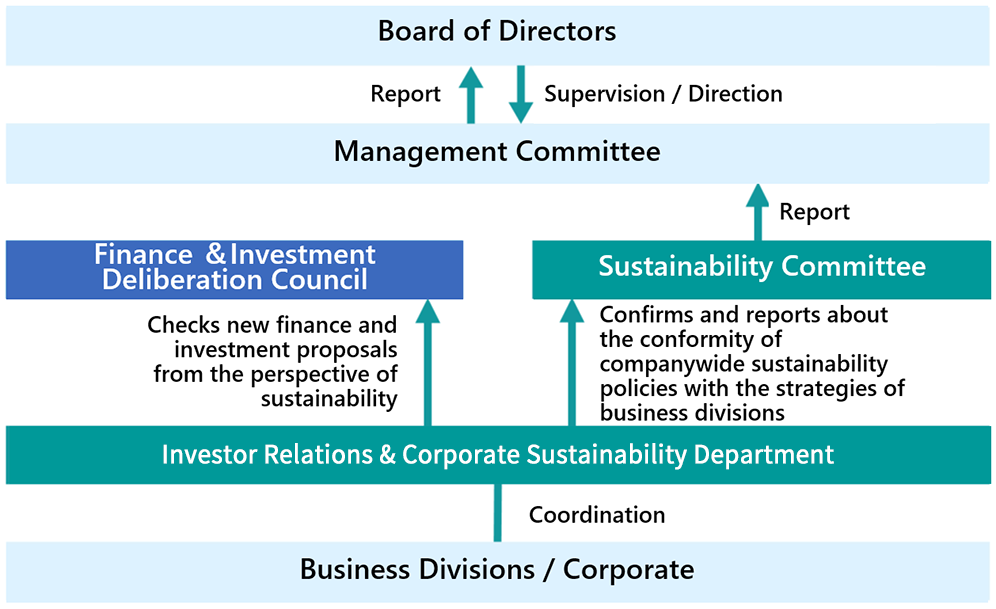
The Sustainability Committee, chaired by the President & CEO, meets at least four times a year. Policies, issues, and other matters discussed by the Sustainability Committee are brought up for deliberation or are reported to the Management Committee and the Board of Directors. The Board of Directors supervises this process and gives directives as necessary.
Risk Management
The Sustainability Committee evaluates and identifies GHG emissions risks in each business conducted by Sojitz Group.
In addition, Sojitz confirms individual business risks as part of the deliberation process of the Finance & Investment Deliberation Council and shares this information with each business division through the Management Committee.
Strategy
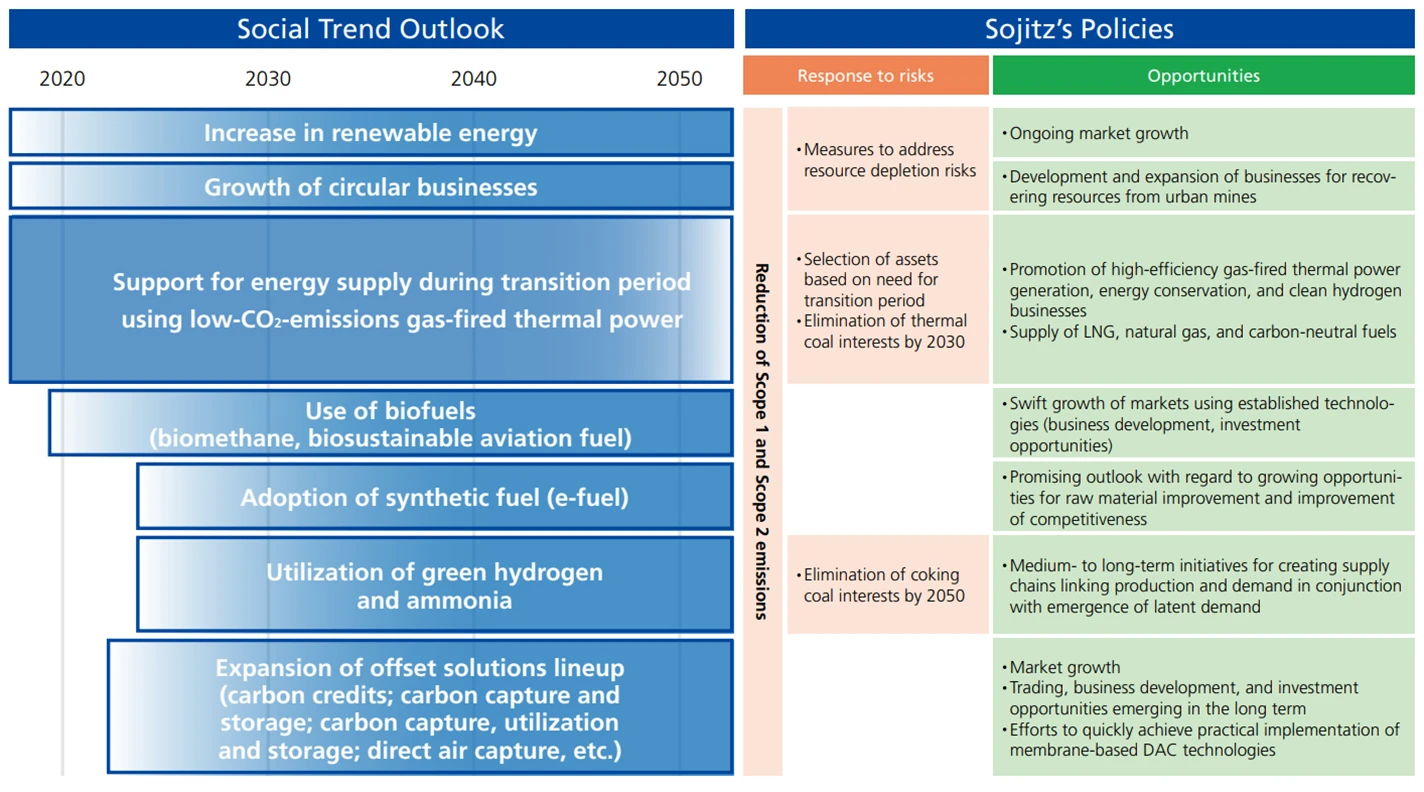
【Formulating Sojitz’s actions and approach based on anticipated technological trends for each decade】
Sojitz identifies the technological and global trends of each decade and organizes its perspectives and policies based on risks and opportunities for Sojitz. Sojitz will continue to monitor external trends and review its approach.
【Increasing “Green” Portion of Assets】
-
<Approach>
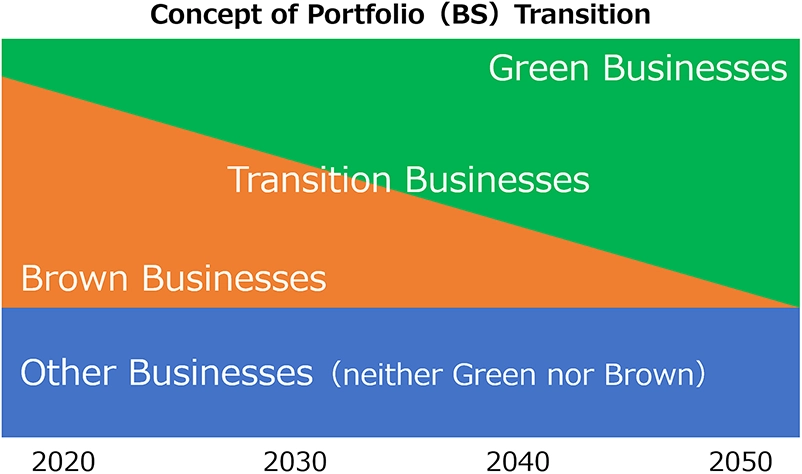
Reduce share of GHG-heavy Brown businesses (e.g., coal interests and related assets), increase share of Green Businesses that contribute to GHG reduction in society and “Transition Businesses” which support the transition, so as to make overall business portfolio greener.
Global debate still ongoing on definitions of green, brown, and transition. Developments to be monitored, including the most-advanced EU taxonomy.
-
1-3. Transition Risks
【Conducting scenario analysis of future risks and opportunities】
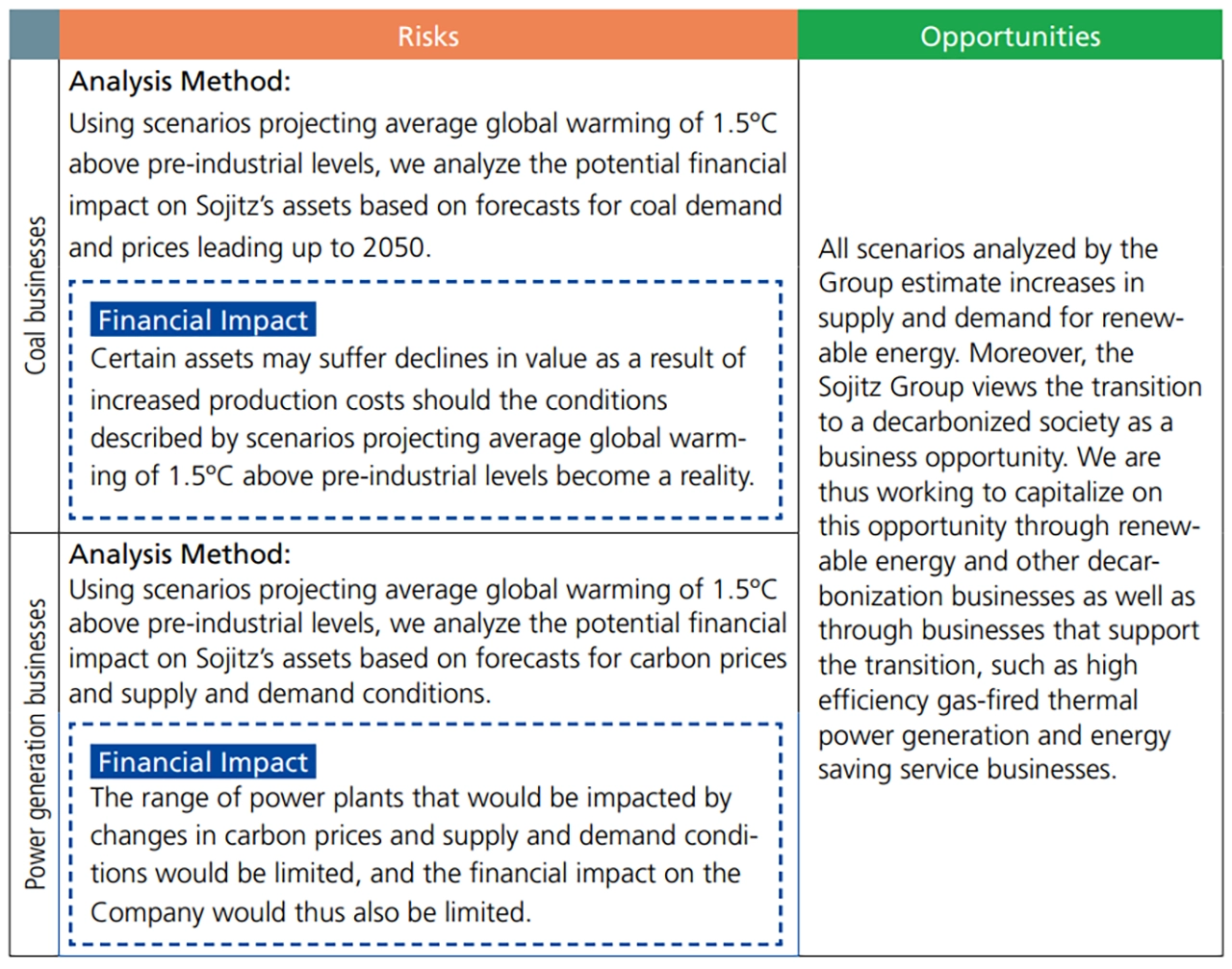
Based on external investigations and internal analysis, we conduct scenario analyses for business fields that are considered to have significant impacts—in terms of risks and opportunities—on our Group’s business activities, management strategy, and financial planning, and analyze their financial impacts.
1-4. Physical Risks
In addition to the transition risks described above, Sojitz is also taking measures to address “physical risks” in the event that climate change cannot be sufficiently mitigated and global warming continues to progress. As an initial step, we are conducting detailed assessments focusing primarily on water-related risks such as floods and droughts.
To broadly assess the potential impacts on our business, we conduct regular surveys using Aqueduct, a water risk assessment tool developed by the World Resources Institute (WRI), which references scenarios such as the 4°C scenario (RCP8.5).
As part of our response to physical risks classified under the TCFD framework, we identify assets that may be exposed to flood risk, which is considered an acute and urgent issue, and assess their financial impacts. As a result, the value of tangible fixed assets (excluding leased assets) located in areas rated as “Extremely High” or “High” risk in the Aqueduct assessment is estimated to be approximately JPY 31 billion as of the end of March 2026.
Metrics and Targets
Sojitz Group has established its policies and targets to fulfill its commitment to contributing to the realization of a decarbonized society, as set forth in Sojitz’s long-term sustainability vision for 2050, the “Sustainability Challenge” and has been promoting initiatives based on these policies and targets.
In response to changes in the external environment surrounding decarbonization and ESG, as well as changes in the Group’s business portfolio, Sojitz has set a new interim target for 2035 toward achieving net zero by 2050, in addition to the existing 2030 target. At the same time, in March 2026, Sojitz revised its decarbonization policy to further promote not only the reduction of its own GHG emissions but also the creation of avoided emissions through its business activities.
● Sojitz Group's Policies Toward Achieving a Decarbonized Society Click for details
Targets
[Scope 1・Scope 2 Targets]
2030 Target
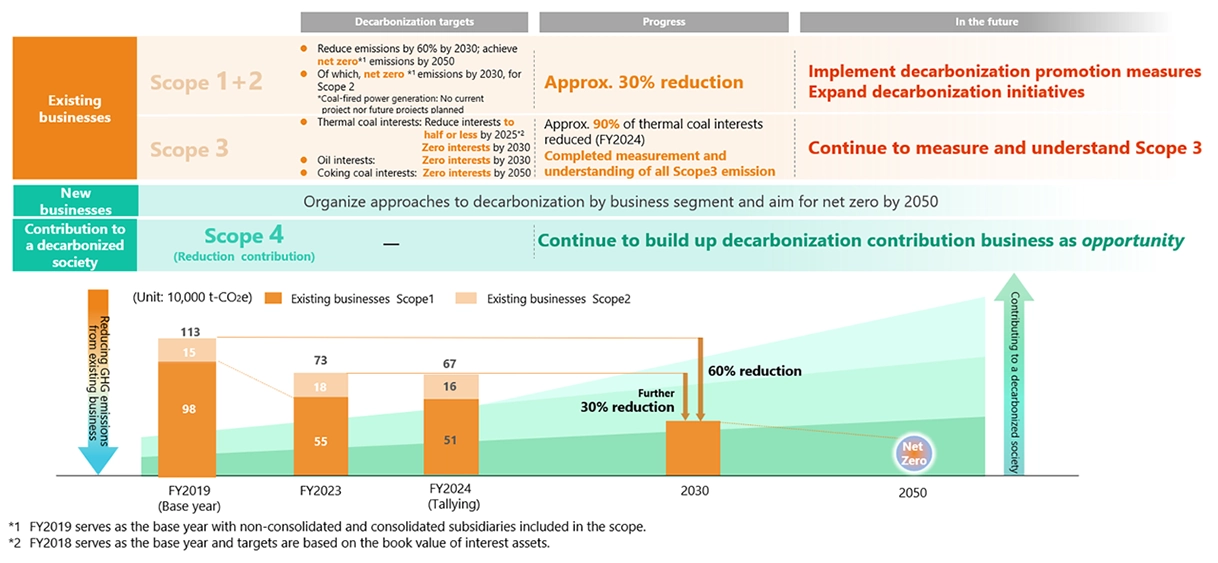
For businesses in operation as of FY2019, Sojitz aims to reduce energy-related CO2 emissions by 60% by 2030 compared with FY2019 levels, including achieving net-zero for Scope 2.
2035 Target
For businesses in operation as of FY2024, Sojitz aims to reduce total GHG emissions by 40% by FY2035 compared with FY2024 levels, including achieving net impact zero* for Scope 2. For businesses thereafter, Sojitz aims to achieve net zero by 2050.
* Net impact zero means a concept whereby Sojitz’s own emissions are reduced to zero after deducting carbon removals and offsets, as well as avoided emissions achieved through its businesses.
| Scope1・Scope2 | ・Net zero by 2050 (Scope 1・Scope 2) ・Businesses in operation as of FY2019: 60% reduction in energy-related CO2 emissions by FY2030*1 Including net zero for Scope 2 by FY2030 ・Businesses in operation as of FY2024: 40% reduction in GHG emissions by FY2035*2 Including net impact zero for Scope 2 by FY2035 |
|---|---|
| Coal-fired power generation | Sojitz currently has no coal-fired power generation assets and does not plan to acquire any in the future. |
Scope of reporting: These targets apply to Sojitz Corporation (non-consolidated), all consolidated subsidiaries in Japan and overseas, and unincorporated joint ventures subject to reporting under Sojitz’s management control approach.
*1 Energy-related CO2 emissions, with FY2019 as the base year.
*2 GHG emissions, with FY2024 as the base year.
[Scope 3 Targets (Natural Resource Interests)]
Scope 3 refers primarily to GHG emissions generated throughout the supply chain. Trading companies are involved in extensive supply chains ranging from upstream to downstream.
As of FY2019, if all of Sojitz’s resource interests were combusted, the resulting GHG emissions would amount to approximately 200 million tons, far exceeding the approximately 1 million tons of GHG emissions generated from the Sojitz Group’s own direct energy use (Scope 1・Scope 2).
In recognition of the heightened social responsibility associated with resource interests, we have set out the following policies and targets since 2019.
Targets for Resource Interests Businesses
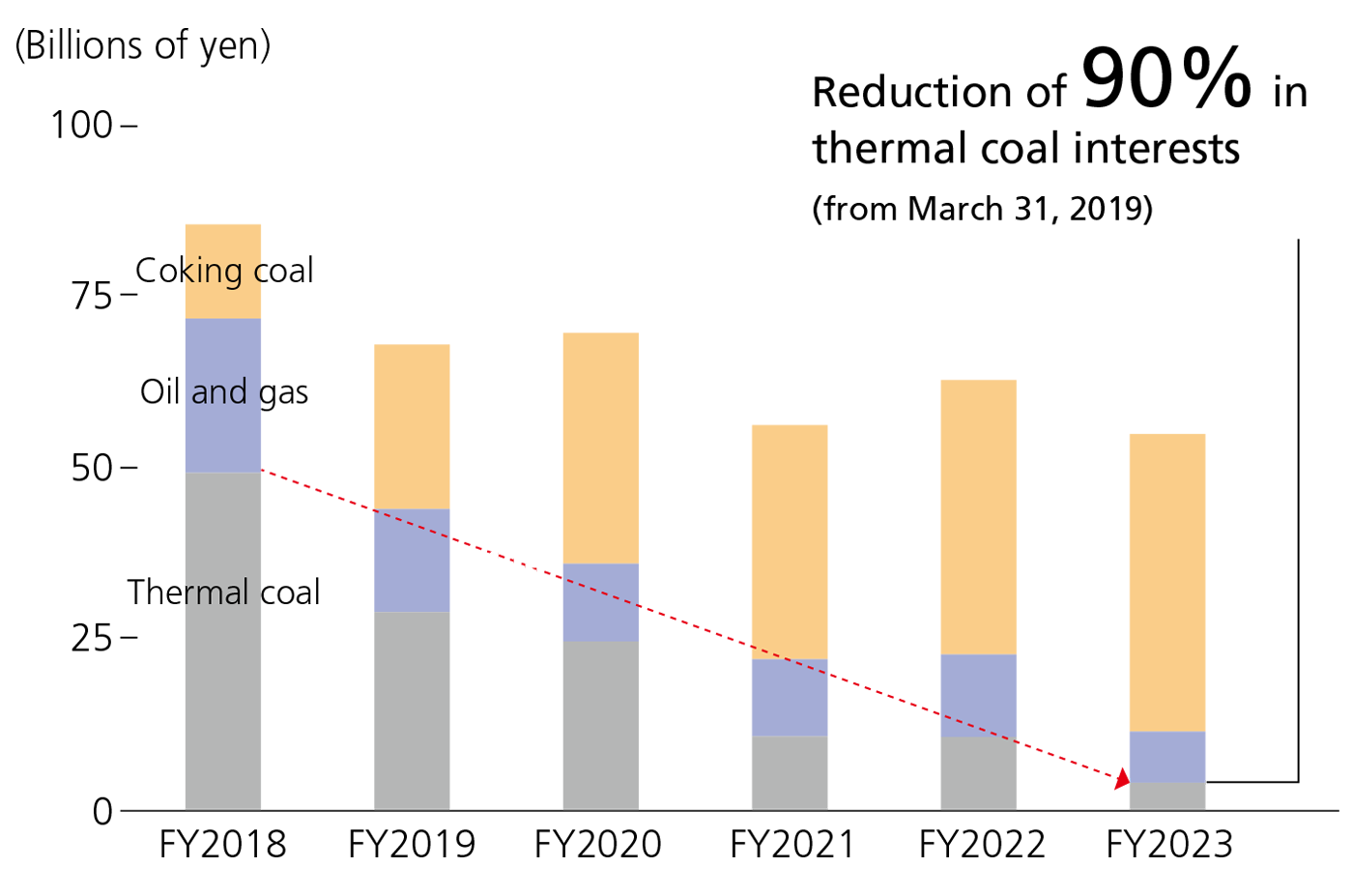
| Thermal coal interests | Reduce to half or less by 2025; zero by 2030 *3 |
|---|---|
| Oil interests | Zero by 2030 |
| Coking coal interests | Zero by 2050 |
- *3 Based on the book value of asset holdings in resource interests, with FY2018 as the base year.
As described above, Sojitz has developed a roadmap that outlines technological trends and social developments by decade on the path toward a decarbonized society, and, based on this roadmap, examines and organizes its responses and approach.
The above targets have been formulated taking into account such forward-looking assessments, including the future operating environment and actual business conditions. Accordingly, these targets are based on current future assumptions and will be flexibly reviewed in response to changes in social trends and the pace of technological innovation.
Progress
Progress Toward the 2030 Target
Scope 1 and Scope 2 : For businesses in operation as of FY2019, emissions have been reduced by 40% compared with FY2019 levels as of March 2026, against the target of a 60% reduction by 2030.
Scope 3 (thermal coal interests) : Against the targets of reducing to half or less by 2025 and to zero by 2030, reductions of 90% have been achieved as of March 2026.
Reduction of Emission in Resource Interests:
Progress toward the 2035 targets will be disclosed starting with results for the fiscal year ending March 2027.