
Sojitz’s Small-Scale Distributed Solar Power Business in Japan:
Leading Corporate Decarbonization Through Off-Site PPAs
Oct. 24, 2025
Oct. 24, 2025
With a growing number of companies pursuing carbon neutrality, leveraging renewable energy sources that emit no greenhouse gases has become a major priority. Sojitz entered the solar power business in 2009 and has since been involved in the development and operation of renewable energy power plants with a total capacity of approximately 2 million kilowatts,*1 both in Japan and overseas. Sojitz drew upon this experience to launch a new business supplying renewable energy to corporate clients in Japan through off-site corporate power purchase agreements (PPAs). The company has concluded multiple off-site corporate PPAs, including an agreement with Kansai Electric Power Company (KEPCO) and West Japan Railway Company (JR West Japan) in 2023 and a contract with KEPCO and Osaka Titanium Technologies Co., Ltd. (Osaka Titanium Technologies) in 2025. This feature provides an in-depth look at Sojitz’s small-scale distributed solar power business in Japan.
- Sojitz entered the solar power business in 2009 and currently supplies renewable energy to a range of corporate clients in Japan to support their carbon neutrality initiatives
- Through off-site corporate PPAs, Sojitz is supplying power that aligns with RE100 standards*2 and ensures additionality, a key metric for power projects that measures whether the creation of a new facility results in a tangible increase in renewable energy capacity
- Sojitz concluded one of the largest corporate PPAs in Japan with KEPCO and JR West Japan, and the company aims to install 3,000 new small-scale distributed solar power plants in Japan by FY2026
Today, Japanese companies are taking swift steps to implement a decarbonization-driven business management strategy as efforts to achieve net-zero carbon emissions by 2050 advance and carbon neutrality mandates come into effect domestically. Particularly in Japan, where over 80% of greenhouse gas emissions are energy-related,*3 the widespread adoption of non-fossil power sources and renewable energy is a critical next step.
Sojitz first entered the solar power generation business in 2009. As of May 2025, the company’s track record now includes development and business management of renewable energy power plants, located both in Japan and overseas, with a total capacity of approximately 2 million kilowatts. In addition to its mega-solar projects, Sojitz is now applying this existing expertise to the development of small-scale solar power plants in Japan. These distributed energy facilities are built on unused land and can be flexibly adapted to each specific environment.
*3: Source: Japan’s National Greenhouse Gas Emissions and Removal in FY2023 (Ministry of the Environment, April 25, 2025)
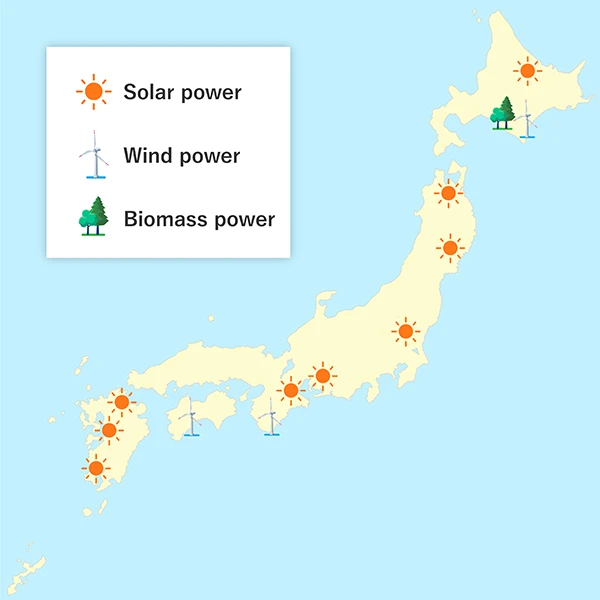
Sojitz’s renewable energy projects in Japan
Companies currently have three main options for sourcing renewable energy: 1) generate energy in-house by installing equipment such as rooftop solar panel systems, 2) purchase an energy company’s renewable energy plan, or 3) contract directly with a power producer to receive electricity generated off-site via power transmission lines. Companies also incorporate the purchase of non-fossil certificates (NFCs) and renewable energy certificates (RECs) as part of a decarbonization-driven business management strategy. These certificates, sometimes broadly referred to as “green attributes,” represent proof of the environmental benefit created when non-greenhouse gas emitting renewable energy is generated. Amidst this current landscape, the corporate PPA is one approach gaining traction among consumers as an energy scheme in which companies directly contract with a power producer for their energy needs.
The corporate PPA is gaining popularity with multinational corporations and some major Japanese companies as a new strategy for achieving decarbonization-driven business management, and an increasing number of organizations in Japan are opting for these arrangements. As decarbonization efforts accelerate, the demand for renewable energy and green attributes is expected to far exceed supply. At the same time, the RECs and other certificates that originate from newly established projects with proven additionality are likely to become scarcer and more valuable in the future. Typically structured as long-term contracts, corporate PPAs are being recognized as an effective way to hedge against the costs associated with securing these green attributes.
The launch of the feed-in tariff (FIT) system for renewable energy in Japan accelerated the development of many mega-solar power plants and other solar projects throughout the country. However, Japan’s limited land area means that the land suitable for ground-mounted solar plants is significantly decreasing. At the same time, the renewable energy needs of companies pursuing decarbonization are only diversifying—in terms of scale, timeline, space, and budget.
Sojitz created a flexible solution to address these diverse needs by developing a small-scale distributed off-site corporate PPA business that provides both renewable energy and green attributes to customers. By developing new solar power plants on unused land in regions that are difficult to service through mega-solar plants, Sojitz can bundle the necessary output from multiple sites to meet demand. This business model minimizes environmental impact by avoiding deforestation and contributes to local communities through initiatives such as supplying emergency power during disasters.
Sojitz is currently developing its off-site PPA business under two energy schemes—physical PPAs and virtual PPAs.
Physical PPAs are arrangements that involve the trade of both actual electricity and RECs. These agreements primarily feature long-term contracts with a fixed price, and the ability to source renewable energy at a predictable cost represents a major advantage for energy consumers. This energy scheme is better suited for cases in which the consumer and power plant are located within a power grid operated by the same transmission and distribution utility (TDU).
In contrast, virtual PPAs involve only the transfer of RECs and are therefore not constrained by the location of the consumer. These agreements also involve long-term contracts, but customers can purchase power without modifying the existing contract with their energy company.
The electricity and RECs provided by Sojitz’s small-scale distributed power facilities come from newly developed power plants. This ensures that customers can operate in alignment with RE100 standards and source renewable energy with additionality, an increasingly important metric.
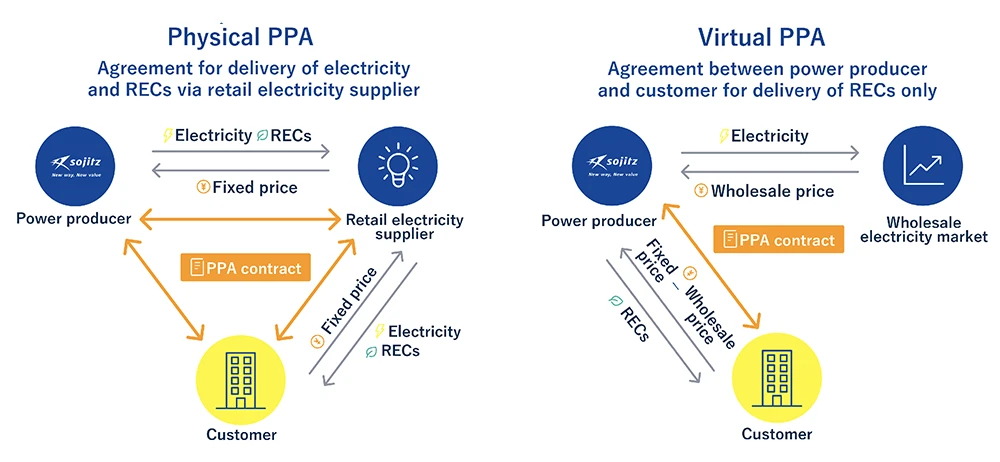
| Physical PPA | Virtual PPA | |
|---|---|---|
| Transaction Content | Electricity and RECs | RECs only |
| Contracting Parties | Power consumer (customer), retail electricity provider, power producer | Power consumer (customer), power producer |
| Contract Duration | Typically 20+ years | Typically 20+ years |
| Pricing Structure | Fixed price (contract price) | Contract-for-differences settlement (difference between wholesale price and contract price) |
| Associated Changes to Existing Power Contracts | Customer must adjust existing contract with retail electricity provider | No contract modifications necessary |
| Power Plant Location Restrictions | Customer and power plant are typically located within the same power grid | No limitations on location or proximity |
Physical vs. virtual PPAs
Sojitz possesses expertise and an extensive track record in both power plant development and operation. The power generation business often involves complex schemes and procedures, and there are few companies with the capacity to handle the end-to-end execution of a distributed power project and create a financially sound business that clients can trust. Sojitz leverages its unique strengths as a general trading company by drawing upon its financing capabilities and existing network of energy consumers. The company relies on its wealth of experience in renewable energy development and operation to create business models that are both reliable and economically efficient.
Sojitz leads a wide range of partners throughout the project lifecycle, from the development and construction of new facilities to coordination with electricity retailers, supply of electricity, and operation of power plant locations. Through an integrated one-stop service model, Sojitz is able to supply customers with fast and reliable renewable energy while also contributing to their decarbonization initiatives.
Building on this established business foundation, Sojitz has cultivated a distributed solar power portfolio and is already providing a wide range of large-scale electricity consumers with both green attributes and the stable supply of renewable energy. In December 2023, Sojitz formed a corporate PPA with KEPCO and JR West Japan. Through KEPCO’s power grid, Sojitz will provide JR West Japan with renewable energy and RECs generated at a dedicated solar power plant developed, owned, and operated by Sojitz. The plant will supply power to operate JR West Japan’s major train lines, including the JR Kyoto Line and JR Kobe Line. The project is slated to begin operations in FY2027 and is among the largest corporate PPA developments in Japan, with an estimated output of 75,000 kilowatts. JR West Japan’s rail network forms a vital part of the nation’s social infrastructure system, and this initiative will provide the company with a reliable long-term supply of green energy and add value by supporting JR West Japan’s efforts to reduce CO2 emissions and ensure stable business management.
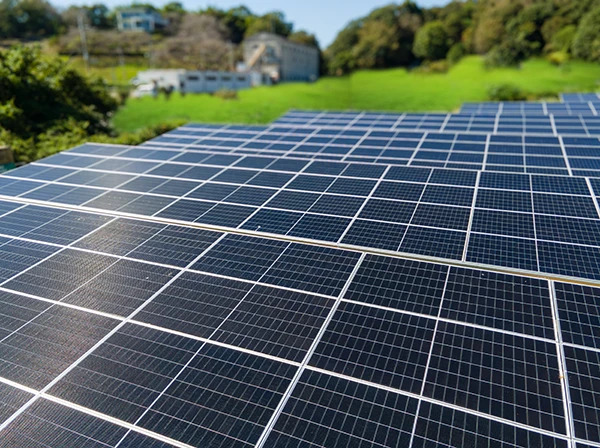
Sojitz solar power plant constructed on vacant land
In June 2025, Sojitz concluded a corporate PPA with KEPCO and Osaka Titanium Technologies. Under this contract, Sojitz will provide renewable energy to Osaka Titanium Technologies for a 20-year period. The power will be sourced from a total of approximately 200 solar power plants with a 10,000-kilowatt capacity developed and operated by Sojitz and its subsidiary, Sojitz Mirai Power Corporation. Sojitz is scheduled to begin supplying to Osaka Titanium Technologies in October 2025. The power will be used in the operation of the company’s Amagasaki plant and is anticipated to reduce the facility’s CO2 emissions by roughly 8,000 tons annually. In addition, Sojitz has also signed a corporate PPA with Hanshin Electric Railway Co., Ltd. (Hanshin Electric Railway) and KEPCO for the development of roughly 200 dedicated solar power plants with a 10,000-kilowatt capacity, with plans to begin supplying power in FY2026.
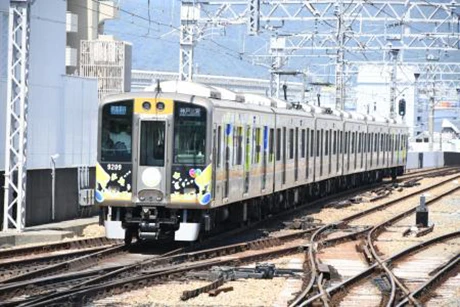
Under the PPA with KEPCO and Hanshin Electric Railway, Sojitz will provide RECs as well as renewable energy that will be used to power Hanshin trains, stations, and other facilities
(Photo credit: Hanshin Electric Railway)
Looking ahead, Sojitz has set a target of installing 3,000 new small-scale solar power plants in Japan, each with an output in the 50-kilowatt range, by FY2026. Through these efforts, Sojitz is contributing to the development of the domestic solar power industry, improving the nation’s energy self-sufficiency, and ensuring a stable supply of electricity.
Beyond its corporate PPA projects, Sojitz is involved in a diverse range of initiatives in the energy solutions sector, and the company sees great potential for new ways to contribute to local communities and meet diverse client needs through these businesses. Sojitz will continue to expand its functions and develop new solution-based business models that stay one step ahead of ever-evolving needs around the world.