
Last
JPY
JPY
(%)
Securities Code : 2768
Last
JPY
JPY
(%)
(Real Time)
JPY
%
BN JPY
In our quest to craft the Sojitz Growth Story, we found ourselves pressed to reexamine whether or not we were sufficiently focused on ensuring that we had a path to success in our business ventures. This introspection revealed that there were some cases in which our focus on answering this important question might not have been sufficient.
It is true that Sojitz is making steady progress in advancing toward its next stage as described in Medium-term Management Plan 2026. During the year ended March 31, 2026, the second year of this plan, we conducted a number of large-scale investments aimed at furthering us toward our goal of doubled corporate value. One example would be the acquisition of Australian infrastructure developer Capella Capital Pty Ltd. At the same time, we have been taking rational steps to remedy businesses in which Sojitz will not feasibly be able to continue generating value. For instance, we might transition to a joint-operation arrangement with another partner or withdraw completely. Alternatively, we could drastically rework the framework of the business division that oversees a given business in addition to transforming the business itself.
We have also been disclosing, both internally and externally, such underperforming businesses in which we cannot find a clear path to success. There have been cases of issues that were initially obscured by strong market conditions coming to light after changes in the operating environment. In some cases, we made the decision to invest based purely on anticipated market growth without having identified a clear path to success or considered how we would provide value and grow earnings. It was not uncommon in such cases for earnings growth to struggle or for us to be unable to recover our investment when markets took a downturn. There were also cases in which we failed to sufficiently operate a business or manage costs in a manner that minimized downside. These shortcomings were often seen in cases when the earnings structure of the particular business had limited upside potential aside from benefiting from favorable market conditions. One common thread running through all of these cases was that we were dependent on highly uncertain external factors, such as market growth and conditions, and that we had not clearly considered Sojitz’s strengths or path to success. It would seem as though we thought that our hard work would be enough to succeed. It was as though we had invested before determining a clear path to success that took into account the gap between reality and our goals and identified the necessary steps we would take to bridge that gap and succeed. I think our proactive disclosure about these underperforming businesses has had benefits from the perspective of sharing information about such issues internally and raising frontline awareness.
When assessing businesses that are underperforming, it is important that we do not blame our failure on changes in the operating environment. Rather, we must look at the accuracy of the decisions we make, which is something that we have the power to control. At the end of the day, what we have found to be lacking in underperforming businesses was the perspective of whether Sojitz was able to really create value in, or act as the most ideal owner of, a given business. It is important that we remain keenly aware of this perspective when making new investments and also when reviewing existing businesses. We must constantly ask ourselves whether a business really deserves a place in Sojitz’s portfolio and endeavor to make decisions with an eye toward maximizing business value. This is the approach we will take toward optimizing our business portfolio.
Sojitz has never been the type of company that is dependent on a specific business, rather taking the path of creating new businesses as deemed viable based on the changes it predicted. Sojitz’s DNA comprises future forecasting, innovative transformation, and challenge-taking spirit. This DNA can be traced back to our inception, more than a century ago, and continues to serve as the basis for our business decision-making process even today. We must assume that the operating environment will continue to change. Based on this assumption, we should constantly reevaluate Sojitz’s position and seek to generate value in areas where we can succeed. This approach is an extension of our DNA.
Sojitz’s competitive edge is not something that can be defined through comparison to other general trading companies. This is because, although we share a business model with such companies, we rarely compete in the specific businesses in which we engage. It is thus more important that we assess exactly where Sojitz stands in comparison to the other players operating in the specific business fields that we are engaged in. Specifically, our focus is on our ability to secure a leading position in niche markets. For this reason, we must be able to identify whether or not Sojitz can secure and maintain a competitive edge in specific fields. This undertaking must be based on a deep understanding of the targeted business structure, meaning that we must have a structural understanding of exactly where we will generate value. It is only when we have such understanding that we will be able to identify where we have the potential to achieve a competitive position.
Given this approach toward our business, it becomes clear that we should not create a rigidly fixed idea of what constitutes Sojitz’s strengths. As the operating environment changes, so will the areas in which Sojitz can be competitive. Accordingly, it is crucial that we continue to build our track record in business areas where Sojitz can truly succeed, even as we continue to replace the businesses in our portfolio as deemed appropriate based on changes in the operating environment.
This approach I have described thus far is not just a policy that we talk about; it is a common standard that we have been using in our investment decisions. As for projects for which we are unable to objectively explain our path to success, we look to remove such undertakings from the list of candidates at the early stages of investment screening. This should result in a more rigorous investment decision-making process, but that does not mean that we will not be taking risks. Quite the contrary; when we have a clear view of our path to success, we will be able to proceed with even more confidence, helping us better tailor our investment decisions to the actual circumstances.
I expect our employees to, first and foremost, be able to think autonomously. They should not just accept the premises presented to them. Rather, they should be able to fully understand the ideal approach for a given business and how they will create value therein so that they can effectively explain this approach. This is why I try to discourage self-centered thinking. It is important to be passionate about one’s job, but passion alone is not enough. We cannot just focus on what we want to do; we have to be objective, thinking about what is best for the business and who is the most suited to a given role.
It is difficult to tell whether or not we are practicing this type of thinking just by looking at the decisions made in a single project. However, we can get glimpses of the extent to which a person is thinking independently, and the underlying assumptions that shape their thinking, during everyday communication and exchanges. I too attempt to get an idea of the thought processes and decision-shaping assumptions held by employees during my everyday interactions with them.
The organizational reforms and executive staffing decisions undertaken in April 2026 were not based purely on results but were rather shaped by the perspective of how we view businesses, how we organize strategies, and our ability to explain those strategies. We are not simply seeking the ability to explain individual projects. No, what we emphasize is the capacity to explain our businesses. More specifically, we should be able to effectively understand what needs to be done in relation to our existing businesses, what type of value we can generate in the short term as well as in the medium to long term, and whether the businesses and value we create are necessary for the society of the future.

At the same time, I realize that there is a limit to the degree to which we can enhance our decision-making capabilities on the organization-wide level if we only focus on the autonomy of individuals. Our aims include heightening objectivity to align thought patterns and thereby produce more accurate decisions. Accomplishing these aims will require that we actively incorporate the diverse perspectives of others and practice a type of receptiveness that will allow us to fully digest those perspectives. We are currently in the process of advancing measures to foster a culture of providing feedback and heighten the coachability of our employees to help instill such thinking throughout the organization.
Specific measures include developing feedback standards and compiling these standards into guidebooks to be distributed to all employees. We are also providing both online and in-person feedback training. We want feedback to be offered on an everyday basis, instead of being limited to periodic personnel evaluations and one-on-one meetings. Such everyday feedback is being promoted to help individual employees adopt more productive thought processes.
These measures are not just about human capital development; they are ultimately aimed at enhancing decision-making capabilities regarding business investment and improving capital efficiency. Increases to the number of people who can think with autonomy and make objective decisions will no doubt enhance the decisions we make during the course of our business and thereby contribute to earnings growth. Conversely, we cannot expect to generate value if we do not think about how we conduct our business. However, I am confident that investments in human resources aimed at enhancing organization-wide decision-making capabilities will fuel our growth over the medium to long term. Moreover, when people are effectively trained and able to think independently, they will be more motivated in their work, which will in turn contribute to stronger organizational capabilities.
The organization-wide decision-making approach being refined through these initiatives is already being applied to actual investment decisions and business reviews. In all cases where this approach is applied, we focus not so much on whether a given business is operating in a growth field, but rather on the position that will allow Sojitz to make contributions and the types of value it can produce.
One of the projects where this is most visible is the acquisition of Australian infrastructure developer Capella. Factors considered when undertaking this investment included how, based on the insight gained from examining similar projects, involvement in the public–private partnership field should enable us to apply and build upon the expertise Sojitz has gained through involvement in other projects and thereby expand our pipeline. Our pipeline has been an issue for some time, you see. We also anticipated that the earnings opportunities to be seen in each phase of this multiphase project would help support reliable and growing earnings.
The same could be said of our investment in NIPPON A&L INC. in the Chemicals Division. This project has been positioned as an extension of our more than two decades of experience in the battery material business. We made the decision to invest based on our belief that greater value could be generated by leveraging our years of insight and relationships with customers to get involved in manufacturing in addition to trading.
We are also applying these decision-making standards when reviewing existing businesses. In our retail businesses in Vietnam, for example, we had acknowledged that our prior approach toward hands-on operation had not allowed these businesses to grow to their full potential. To address this issue, we are collaborating with a major Vietnamese retailer and distributor. We are currently exploring the possibility of utilizing this company’s various distribution channels and vast insight to further grow these businesses. In this manner, by thoroughly examining what would be the ideal approach toward growing these businesses, we arrived at the decision to build the optimal business management framework through partnerships in fields where it would be difficult for Sojitz to succeed alone.
In both projects, what ended up being important was for us to clearly identify the specific fields and positions in which Sojitz would be able to generate value. We will continue to apply this approach to both new investment decisions and reviews of existing businesses. As for fields where Sojitz’s involvement might no longer be necessary, we will examine the possibility of revising our involvement or even withdrawing, as opposed to committing ourselves to ongoing participation.
The operating environment continues to face ongoing uncertainty. We are seeing increasingly intense changes that cannot be explained simply in terms of economic rationality, and these changes are cropping up in areas ranging from resources and energy to logistics and supply chains. In fact, it is becoming ever more common for trends in international relations and government policy to influence the very assumptions that shape how we do business.
Looking at resources like rare earths and uranium, for example, we will see that such resources are becoming incredibly more important, not just in terms of prices or the supply–demand balance, but also in terms of economic security concerns like dependency on specific countries and supply reliability. Similar changes can be seen in terms of carbon neutrality. This topic is no longer being discussed predominately in terms of decarbonization; greater emphasis is being placed on how to strike a balance with energy security and supply reliability.
As I have discussed thus far, at Sojitz we have been focusing on decision-making standards that look at where we can create value when examining investments and reviewing businesses. This approach is not just important when it comes to deciding whether to invest in specific projects. In a time when the very assumptions on which we base our business are constantly changing, it is vital that we adapt by utilizing our own approach toward decision-making. The more uncertain the environment is, the more important it will be for our decision-making approach to be clear.
In particular, there have been many changes to how we have to think about energy. Decarbonization continues to be an important concern, and there is thus a need to keep moving forward with steadfast efforts to adopt renewable energy. However, it is also becoming more commonly understood that this alone will not be enough. This is especially true in Japan, where we must take a particularly realistic approach toward choosing power sources from the perspective of securing a reliable supply. Nuclear power, for example, is expected to once again rise in importance as a power source that will have a certain role to play over the long term. Sojitz is thus examining nuclear power as a realistic option with eyes toward determining exactly what sort of role it can play going forward. Such clairvoyance, I believe, will help contribute to a more robust supply chain for Japan and a more realistic transition to a decarbonized society in these highly uncertain times.
A bellwether of the changing times is AI. More than the improvements to operational efficiency, the evolution of AI technologies is an indicator that we are entering an era in which the assumptions that form the basis for our decisions are updated on a shorter cycle. This means that we cannot continue to base decisions purely on our prior experience and knowledge, as decisions based only on our knowledge will quickly become irrelevant. This is all the more reason why we must enhance the decision-making capabilities of our people while also utilizing digital and AI technologies to improve the speed and accuracy of decisions made. Sojitz will thus position digital and AI technologies as part of the foundations for enhancing our decision-making capabilities in these times of great uncertainty.
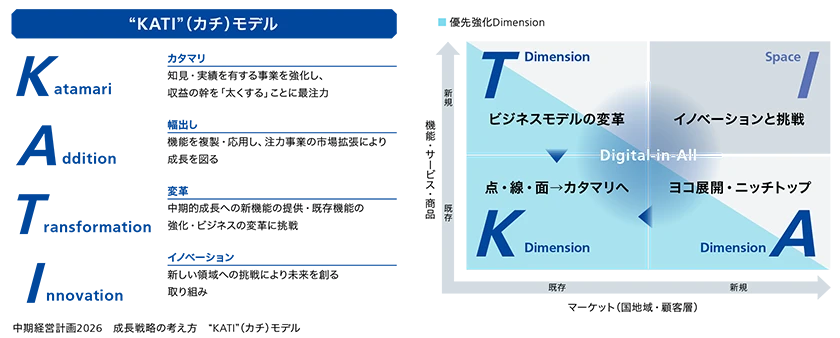
The goal of doubling corporate value described for Sojitz’s next stage is not merely aimed at growing our scale. We must not simply progress down the same path we have walked thus far. Rather, I believe that we are at a stage in which we are pressed to present an even clearer road map of how Sojitz will continue to grow.
It will therefore be important for us to determine exactly where we will allocate our management resources based on a consistent approach toward decision-making, rather than simply expanding our portfolio of standalone projects. As I have mentioned previously, we have been revising our asset portfolio and selecting new investments based on the perspective of whether or not Sojitz is the best company to operate each given business. Through this lens, we will be looking to simultaneously replace existing assets and improve the profitability of our portfolio in order to heighten capital efficiency and ultimately improve corporate value.
Sojitz has set the targets of profit for the year (attributable to owners of the Company) of ¥200.0 billion, ROE of 15%, and market capitalization of ¥2.0 trillion for the Next Stage. These are not just financial targets to be accomplished; they represent levels of performance that we must achieve by revising our business portfolio and conducting investments with a clear view of our path to success.
During the year ending March 31, 2027, I have plans to present at least three new projects of a similar vein to our investment in Capella. These projects, alongside the initiatives that have already been disclosed, will represent areas where we will pursue growth to further us toward our next stage. We will utilize these projects to help us paint an even clearer picture of Sojitz’s growth directives and execution capabilities.
My role is to help Sojitz live up to the expectations of stakeholders by preparing a concise road map for our growth and ensuring that we can produce steady results as we move along this map. Our ability to reach our next stage will not purely be determined by our individual measures; it will be dependent on the extent to which we can achieve the goals of our initiatives. I am therefore committed to guaranteeing our success in these undertakings by improving both the accuracy and speed of decisions to generate steady results.
July 2026
Kosuke Uemura
Representative Director, President & CEO
*Organization affiliations and titles are current as of July 2026.
This Website was created for the purpose of providing information relating to Sojitz corporation. It was not created to solicit investors to buy or sell Sojitz Corporation's stock. The final decision and responsibility for investments rests solely with the user of this Website and its content.
This website contains forward-looking statements about future performance, events or management plans of the Company based on the available information, certain assumptions and expectation at the point of disclosure, of which many are beyond the Company’s control. These are subject to a number of risks, uncertainties and factors, including but not limited to, economic and financial conditions, factors that may affect the level of demand and financial performance of the major industries and customers we serve, interest rate and currency fluctuations, availability and cost of funding, fluctuations in commodity and materials prices, political turmoil in certain countries and regions, litigations claims, change in laws, regulations and tax rules, and other factors. Actual results, performances and achievements may differ materially from those described explicitly or implicitly in the relevant forward-looking statements. The Company has no responsibility for any possible damages arising from the use of information on this website.
Although the information on this website is prepared with the greatest care, the Company does not guarantee the accuracy, continuity or quality of any information provided on this website or that it is up-to-date, nor does it accept responsibility for any damage or loss arising from the falsification of data by third parties, data downloads, etc., irrespective of the reasons therefore.
Please also be aware that information on this Website may be changed, modified, added or removed at any time without prior notice.